


Tax Time Tips: How to avoid overpaying when it comes to healthcare
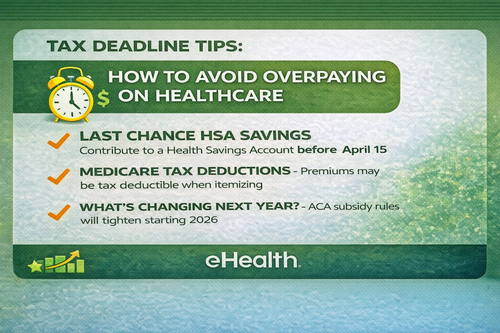
With the tax-filing deadline of April 15 approaching, Americans across the country are making last-minute adjustments to their tax returns.
If you are among them, it is important to understand how medical expenses and insurance choices may affect your return. From maximizing tax-advantaged savings to reconciling subsidies, the right strategies can help you reduce your tax burden for 2025 and plan for healthcare costs in 2026 and beyond.
The tax code evolves each year, so understanding the latest changes is key. Here are some tips for this year and strategies to keep in mind for the future.
There is still time to fund your HSA
Nearly 60 million Americans are covered by a Health Savings Accounts (HSAs) that allows them to save money for future medical costs on a tax-advantaged basis. Even if you haven’t been actively funding an HSA, you can still make contributions before April 15 and assign them to your 2025 taxes.
Contributions to an HSA are made on a pre-tax or tax-deductible basis, reducing your taxable income. Funds in your account can be invested and grow tax-free to help build a pool for future medical expenses. That’s why HSA savings can be so powerful.
For 2025, the HSA contribution limit was $4,300 for individuals or $8,550 for families. Those limits will increase in 2026 to $4,400 for individuals and $8,750 for families. People aged 55 or older can deposit an extra $1,000 per year.
Despite the tax advantages, only 21% of people regularly contribute to an HSA.
What to know if you are enrolled in Medicare
Nearly 70 million Americans are enrolled in Medicare, over half of them in a Medicare Advantage plan. While most Medicare Advantage plans are available without a monthly premium, people with Original Medicare and some Medicare Advantage enrollees will have this on-going expense.
Like many other medical expenses, Medicare premiums may be tax deductible, with some important exceptions. To be eligible, you must itemize your federal return rather than taking the standard deduction, and only the dollar value of the qualified medical expenses that exceed 7.5% of your adjusted gross income are deductible.
For some taxpayers, it may be uncommon to reach that 7.5% threshold for medical expenses. But for Medicare beneficiaries living on fixed incomes and with higher medical expenses, they may be more likely to surpass it.
Key considerations if you have an Affordable Care Act plan
Over 23 million Americans have an Affordable Care Act (ACA) plan and many of them benefit from federal financial subsidies. If you have this type of coverage, you may get additional subsidy help when filing your federal return — or you may have to pay back some of those subsidy dollars — depending on your total income for 2025,
During enrollment, you applied for federal subsidies (known as Advanced Premium Tax Credits), and the amount granted was based on your estimated income. For example, if you estimated your total income for 2025 at $50,000 but ended up earning $35,000 for the year, you may be due more subsidy help. However, if you estimated your income at $50,000 but earned $70,000, you may be required to pay back some or all the subsidies.
With enhanced subsidies currently scheduled to expire in 2026, moving forward this financial assistance will only be available to Americans earning less than 400% of the federal poverty level (about $63,000 for an individual or $132,000 for a family of four).
Before finishing your taxes yourself or with support from a licensed tax professional, it is important to understand your specific situation, with the goals of maximizing your return while maintaining access to quality care now and in the future.
-
Whitney Stidom is vice president of consumer enablement at eHealth, a leading online health insurance marketplace that helps consumers confidently navigate their health benefit decisions.
This article is informational and is not intended to provide, and should not be relied on for, tax or legal advice. If you need tax advice related to health coverage (such as subsidies or penalties), consulting a personal CPA or tax preparer is advised.